Amazon employs a multi-level e-commerce strategy. Amazon started off
by focusing on Business-to-Consumer relationships between itself and its
customers, and Business-to-Business relationships between itself and
its suppliers but it then moved to incorporate Customer-to-Business
transactions as it realized the value of customer reviews as part of the
product descriptions. It now also facilitates customer to customer with
the provision of the Amazon marketplace which act as an intermediary to
facilitate consumer to consumer transactions. The company lets almost
anyone sell almost anything using its platform. In addition to an
affiliate program that lets anybody post Amazon links and earn a
commission on click-through sales, there is now a program which lets
those affiliates build entire websites based on Amazon’s platform.[94]
Some other large e-commerce sellers use Amazon to sell their products
in addition to selling them through their own websites. The sales are
processed through Amazon.com and end up at individual sellers for
processing and order fulfillment and Amazon leases space for these
retailers. Small sellers of used and new goods go to Amazon Marketplace
to offer goods at a fixed price.[95] Amazon also employs the use of drop shippers
or meta sellers. These are members or entities that advertise goods on
Amazon who order these goods direct from other competing websites but
usually from other Amazon members. These meta sellers may have millions
of products listed, have large transaction numbers and are grouped
alongside other less prolific members giving them credibility as just
someone who has been in business for a long time. Markup is anywhere
from 50% to 100% and sometimes more, these sellers maintain that items
are in stock when the opposite is true. As Amazon increases their
dominance in the marketplace these drop shippers have become more and
more commonplace in recent years.[citation needed]
On 2 February 2016, General Growth Properties’
CEO, Sandeep Mathrani, during a year-end conference call with
investors, analysts and reporters mentioned that Amazon plans to roll
out 300 to 400 bookstores around the country. This was an unconfirmed
comment, however, due to the source, a media frenzy ensued.[96]
In November 2015, Amazon opened its first physical bookstore location.
It is aptly named, Amazon Books and is located in University Village in
Seattle. The store is 5,500 square feet and prices for all products
match those on its website.[96]
Friday, January 6, 2017

Amazon's technology
Customer Relationship Management (CRM) and Information Management
(IM) support Amazon’s business strategy. The core technology that keeps
Amazon running is Linux-based. As of 2005, Amazon had the world’s three
largest Linux databases, with capacities of 7.8 TB, 18.5 TB, and 24.7
TB. The central data warehouse of Amazon is made of 28 Hewlett Packard Enterprise
servers with four CPUs per node running Oracle database software.
Amazon’s technology architecture handles millions of back-end operations
every day, as well as queries from more than half a million third-party
sellers. With hundreds of thousands of people sending their credit card
numbers to Amazon’s servers every day, security becomes a major
concern. Amazon employs Netscape Secure Commerce Server using the Secure
Socket Layer protocol which stores all credit card details in a
separate database. The company also records data on customer buyer
behavior which enables them to offer or recommend to an individual
specific item, or bundles of items based upon preferences demonstrated
through purchases or items visited.[91]
On January 31, 2013 Amazon experienced an outage that lasted approximately 49 minutes, leaving its site inaccessible to some customers.[92]
On May 5, 2014 Amazon unveiled a partnership with Twitter. Twitter users can link their accounts to an Amazon account and automatically add items to their shopping carts by responding to any tweet with an Amazon product link bearing the hashtag #AmazonCart. This allows customers to never leave their Twitter feed, and the product is waiting for them when they go to the Amazon website.[93]
On January 31, 2013 Amazon experienced an outage that lasted approximately 49 minutes, leaving its site inaccessible to some customers.[92]
On May 5, 2014 Amazon unveiled a partnership with Twitter. Twitter users can link their accounts to an Amazon account and automatically add items to their shopping carts by responding to any tweet with an Amazon product link bearing the hashtag #AmazonCart. This allows customers to never leave their Twitter feed, and the product is waiting for them when they go to the Amazon website.[93]
Amazon sales rank
The Amazon sales rank (ASR) provides an indication of the popularity
of a product sold on any Amazon locale. It is a relative indicator of
popularity that is updated hourly. Effectively, it is a "best sellers
list" for the millions of products stocked by Amazon.[86]
While the ASR has no direct effect on the sales of a product, it is
used by Amazon to determine which products to include in its
best-sellers lists.[86]
Products that appear in these lists enjoy additional exposure on the
Amazon website, and this may lead to an increase in sales. In
particular, products that experience large jumps (up or down) in their
sales ranks may be included within Amazon's lists of "movers and
shakers"; such a listing provides additional exposure that might lead to
an increase in sales.[87] For competitive reasons, Amazon does not release actual sales figures to the public. However, Amazon has now begun to release point of sale data via the Nielsen BookScan service to verified authors.[88]
While the ASR has been the source of much speculation by publishers,
manufacturers and marketers, Amazon itself does not release the details
of its sales rank calculation algorithm. Some companies have analyzed
Amazon sales data to generate sales estimates based on the ASR,[89] though Amazon states:
Please keep in mind that our sales rank figures are simply meant to be a guide of general interest for the customer and not definitive sales information for publishers—we assume you have this information regularly from your distribution sources
— Amazon.com Help[90]
Third-party sellers
Amazon derives many of its sales from third-party sellers who sell products on Amazon (around 40% in 2008).[81]
Associates receive a commission for referring customers to Amazon by
placing links to Amazon on their websites if the referral results in a
sale. Worldwide, Amazon has "over 900,000 members" in its affiliate
programs.[82]
In the middle of 2014, the Amazon Affiliate Program is used by 1.2% of
all websites, and it is the second most popular advertising network
after Google Ads.[83] It is frequently used by websites and non-profits to provide a way for supporters to earn them commission.[84]
Amazon reported over 1.3 million sellers sold products through Amazon's
websites in 2007. Unlike eBay, Amazon sellers do not have to maintain
separate payment accounts; all payments are handled by Amazon.
Associates can access the Amazon catalog directly on their websites by using the Amazon Web Services (AWS) XML service. A new affiliate product, aStore, allows Associates to embed a subset of Amazon products within another website, or linked to another website. In June 2010, Amazon Seller Product Suggestions was launched (rumored to be internally called "Project Genesis") to provide more transparency to sellers by recommending specific products to third-party sellers to sell on Amazon. Products suggested are based on customers' browsing history.[85]
Associates can access the Amazon catalog directly on their websites by using the Amazon Web Services (AWS) XML service. A new affiliate product, aStore, allows Associates to embed a subset of Amazon products within another website, or linked to another website. In June 2010, Amazon Seller Product Suggestions was launched (rumored to be internally called "Project Genesis") to provide more transparency to sellers by recommending specific products to third-party sellers to sell on Amazon. Products suggested are based on customers' browsing history.[85]
Content search
"Search Inside the Book" is a feature which allows customers to
search for keywords in the full text of many books in the catalog.[78][79] The feature started with 120,000 titles (or 33 million pages of text) on October 23, 2003.[80] There are about 300,000 books in the program. Amazon has cooperated with around 130 publishers to allow users to perform these searches.
To avoid copyright violations, Amazon does not return the computer-readable text of the book. Instead, it returns a picture of the matching page, instructs the web browser to disable printing, and puts limits on the number of pages in a book a single user can access. Additionally, customers can purchase online access to some of the same books via the "Amazon Upgrade" program.
To avoid copyright violations, Amazon does not return the computer-readable text of the book. Instead, it returns a picture of the matching page, instructs the web browser to disable printing, and puts limits on the number of pages in a book a single user can access. Additionally, customers can purchase online access to some of the same books via the "Amazon Upgrade" program.
Reviews
Amazon allows users to submit reviews to the web page of each product. Reviewers must rate the product on a rating scale
from one to five stars. Amazon provides a badging option for reviewers
which indicate the real name of the reviewer (based on confirmation of a
credit card account) or which indicate that the reviewer is one of the
top reviewers by popularity. Customers may comment or vote on the
reviews, indicating whether they found a review helpful to them. If a
review is given enough "helpful" hits, it appears on the front page of
the product. In 2010, Amazon was reported as being the largest single
source of Internet consumer reviews.[73]
When publishers asked Bezos why Amazon would publish negative reviews, he defended the practice by claiming that amazon.com was "taking a different approach ... we want to make every book available—the good, the bad, and the ugly ... to let truth loose".[74]
Although reviews are attributed to the credit-card name of the reviewer, there have been cases of positive reviews being written and posted by a public relations company on behalf of its clients,[75] and instances of writers using pseudonyms to leave negative reviews of their rivals' works.[76]
Following the listing of Untouchable: The Strange Life and Tragic Death of Michael Jackson, a disparaging biography of Michael Jackson by Randall Sullivan, his fans, organized via social media as "Michael Jackson's Rapid Response Team to Media Attacks", bombarded Amazon with negative reviews and negative ratings of positive reviews.
When publishers asked Bezos why Amazon would publish negative reviews, he defended the practice by claiming that amazon.com was "taking a different approach ... we want to make every book available—the good, the bad, and the ugly ... to let truth loose".[74]
Although reviews are attributed to the credit-card name of the reviewer, there have been cases of positive reviews being written and posted by a public relations company on behalf of its clients,[75] and instances of writers using pseudonyms to leave negative reviews of their rivals' works.[76]
Following the listing of Untouchable: The Strange Life and Tragic Death of Michael Jackson, a disparaging biography of Michael Jackson by Randall Sullivan, his fans, organized via social media as "Michael Jackson's Rapid Response Team to Media Attacks", bombarded Amazon with negative reviews and negative ratings of positive reviews.
Website
The domain amazon.com attracted at least 615 million visitors annually by 2008.[69] Amazon attracts over 130 million customers to its US website per month by the start of 2016.[70]
The company has also invested heavily on a massive amount of server
capacity for its website, especially to handle the excessive traffic
during the December Christmas holiday season.[71]
Results generated by Amazon's search engine are partly determined by promotional fees.[72]
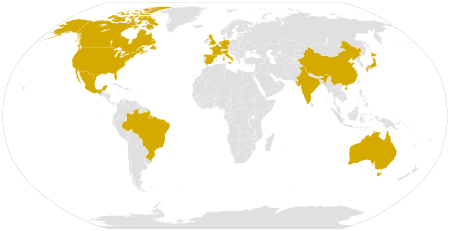 Amazon's localized storefronts, which differ in selection and prices, are differentiated by top-level domain and country code:
Results generated by Amazon's search engine are partly determined by promotional fees.[72]

| Region | Sovereignty | Domain name |
|---|---|---|
| Asia |  China China |
amazon.cn |
 India India |
amazon.in | |
 Japan Japan |
amazon.co.jp | |
| Europe |  France France |
amazon.fr |
 Germany Germany |
amazon.de | |
 Italy Italy |
amazon.it | |
 Netherlands Netherlands |
amazon.nl | |
 Spain Spain |
amazon.es | |
 United Kingdom United Kingdom |
amazon.co.uk | |
| North America |  Canada Canada |
amazon.ca |
 Mexico Mexico |
amazon.com.mx | |
 United States United States |
amazon.com | |
| Oceania |  Australia Australia |
amazon.com.au |
| South America |  Brazil Brazil |
amazon.com.br |
Subscribe to:
Posts (Atom)